| Buy The Motorcycle Diaries Widescreen Edition At Amazon!
|
Compare & Purchase The Motorcycle Diaries Widescreen Edition at Amazon by clicking here!
List Price: —- Amazon Price: Price Too Low To Display! |
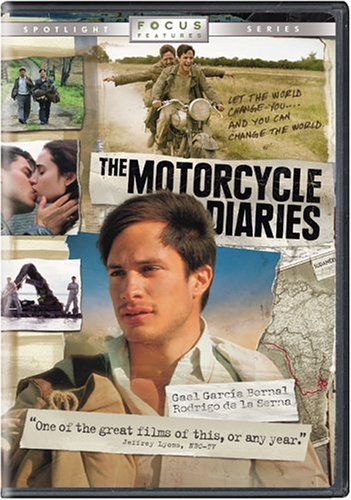
The Motorcycle Diaries Widescreen Edition Description:
An inspirational adventure based on the true story of two young men whose thrilling and dangerous road trip across latin america becomes a life-changing journey of self-discovery. Studio: Uni Dist Corp. (mca) Release Date: 05/22/2007 Starring: Gael Garcia Bernal Mia Maestro Run time: 127 minutes Rating: R
- Amazon Sales Rank: #4017 in DVD
- Brand: Universal
- Released on: 2005-02-15
- Rating: R (Restricted)
- Aspect ratio: 1.85:1
- Formats: AC-3, Color, Dolby, Dubbed, DVD, Subtitled, Widescreen, NTSC
- Original language: Quechua, Spanish
- Subtitled in: English, French
- Dubbed in: French
- Number of discs: 1
- Running time: 126 minutes
Customer Reviews:
“On the Road” with Che Guevara
As most potential viewers know, this film is based on diaries and letters to home written by Ernesto “Che” Guevara during a motorcycle and foot tour of a significant portion of South America during the early 1950s, years before Guevara achieved international renown as a Communist and Latino revolutionary. Thus, the film functions as an attempt to get at the heart of the person who preceded the myth. The film is therefore difficult to judge as pure cinema. Is this, on its own merits, a great film? Or is it a great film about Che Guevara? Interestingly, the person I saw this film with knew absolutely nothing about the subject of the film before it started, and did not connect Ernesto Guevara with Che Guevara until very late in the film. Her reaction was interesting. Until she realized that it was about Che, she says that she considered it a decent but only slightly above average “road” picture, but it gained considerably in her estimation once she realized who the film was about. I think she was correct, and I would agree with those who feel that what merits the film has depends to some degree on who the film is about. If Ernesto hadn’t become Che, it would be a good film but of considerably less interest than it is.
The film does a good job of rooting Che’s eventual concern with the liberation of the oppressed by depicting his broad and constant encounters with everyday people throughout the continent. Camus wrote that it was important to side with the victims and not the executioners, and in his travels Ernesto spends most of his time with the victims. His near-epic exposure to the continent clearly condition his sympathies and inform his vision. At the end of the film it is easy to understand why Che chose a life dedicated to aiding the oppressed in Cuba and elsewhere. The great question left unanswered, and the one reason one can find Che’s life morally troubling, is why he felt that the causes he espoused demanded a violent, military response. Why follow in the steps of Trotsky and Lenin rather than Gandhi? Apart from a single line which merely hints that Che felt violence might be necessary, the film doesn’t come anywhere close to answering this question.
In many ways, the star of the film is the South American continent. I have seen many films over the years set in one corner of the continent or another, but none provided a panoramic view. This film, however, by swinging through Argentina, Chile, Peru, Columbia, and Venezuela provides a graphic impression of the continent’s immense geographical diversity, expanse, and enormous beautiful. I don’t think it would be possible to see this film without a deep urge to visit the land. The scene shot in Machu Picchu reveals the incredible beauty of the site better than anything else I have ever seen.
Gael Garcia Bernal is a remarkably handsome, talented young actor, formerly best known for one of the two young men in Y TU MAMA TAMBIEN, and is outstanding in portraying the young Che Guevara. One suspects that his days as an actor in primarily Latin productions is close to an end, his next several projects originating in Hollywood. Rodrigo De la Serna does not have the enormous charisma of Bernal, but he more than holds his own in the film. The cast is rounded out by a large roster of professional and amateur performers.
Che Guevara is such a controversial figure that this film could elicit a host of differing responses. How one will respond to this film will be deeply conditioned by how one views him. But I do think that it is a film that virtually every viewer will respond to with great interest, and I defy anyone not to find the remarkable landscapes anything short of stunning.
A Myopic Look at an Iconic Figure
This is a tough review to write because of the subject matter we’re dealing with: a militant revolutionary who became Castro’s right-hand man during the 1959 Cuban revolt. But here in THE MOTORCYCLE DIARIES film, we don’t see this man; we see instead the formation of the person whom this man (Ernesto “Che” Guevara played by the talented Gael García Bernal)would become. He’s a young idealist living in South America when he and a friend (Alberto Granado played by up-and-coming actor Rodrigo de la Serna) decide to take a road trip across the continent before bellying down into their chosen carriers in medicine.
The film succeeds in giving us a very myopic view of these two men: Guevara for the initial changes he begins to go through as he witnesses injustices to the low and poor; Granado for his love of women and grudging dedication to Guevara. We travel with them on a 1939 Norton 500 motorcycle (my hat’s off to the two actors who had to ACTUALLY learn to ride one of these behemoths!) as they argue with each other over money, their deficient form of transportation, and Guevara’s unflinching honesty when asked delicate questions (this is brought into focus when they first meet a man - who looks very German - in a small village and asks Che and Granado to look at a lump on his neck, which Granado diagnoses as a cyst but Che calls a tumor).
The cinematography was done exceptionally well on a small budget. The beauty of Machu Picchu, the green forests of Peru, the nothingness of various deserts, all added great visuals for the viewer.
The film’s faults lay with its omissions. Yes, Che was a thinking man. Yes, Che was concerned with humanity as a whole. But Che was also somewhat of a bigot. He didn’t like blacks, jews, and homosexuals (read the book THE MOTORCYCLE DIARIES). So when he shows his concern for lepers in a colony along the Amazon River, we’re only see a part of this complex man. Granted, for a film you need to have your audience empathize with the main character, but this also pulls us into the shallow end of the depths that this man was. The convoluted sections of Che’s life might have added an extra level of understanding for film viewers, especially those who have knowledge of his later life when he becomes an executioner of spies and deserters, quite a dichotomy compared to the hippocratic oath he took when becoming a doctor - the oath basically promising to “do no harm.”
But, again, I can understand why the film makers decided to omit these sections. We are, after all, seeing only the early life of Che, a fomenting of ideas that would change his life forever. But I think we have to be careful when looking at such a potentially volatile subject and controversial man, and only showing the “sunnier” side of Che to a new generation of movie-goers. More research is needed if one really wishes to understand the levels of Che.
Buddy Picture Reaches Far Deeper Into the Heart
When I visited South America on my own extended trip a couple of years ago, I was amazed how many times I saw pictures of Che Guevara everywhere I went….cafes, outdoor bulletin boards, art galleries, even department stores. Now I understand why. Having just read his diary, I was greatly anticipating this film, and my interest only heightened when I started seeing the travelogue shots in the previews. I am happy to report the film surpasses my expectations on almost every level. It is exquisite - perceptively directed, beautifully photographed and wondrously acted by a cast headed by two charismatic actors who tap deep into the hearts and souls of their characters. Whereas the book is more observational, the movie provides a more involving feeling in its portrait of a young man on the brink of his political awakening. It starts out somewhat deceptively as a comic buddy picture with the young Ernesto Guevara (pre-Che), a medical student, leaving his family and accompanying his seemingly more worldly pal Alberto Granado, a biochemist, on a dilapidated 1939 Norton motorbike traversing South America from their native Buenos Aires to Caracas. It is obvious what Alberto’s hormonally charged intentions are on this months-long journey, but at 23, Ernesto is at a more sensitive juncture in his life where his encounters and observations have a deeper impact on his ideology.
What I really like about the film is how it changes in tone and texture as the boys’ hunt for adventure evolves into life-changing experiences for both of them. The motorbike acts as a metaphor for this change, as it unsurprisingly breaks down forcing them to open their eyes to the poverty and quiet struggle of the local people in each of the countries they visit. The story winds through wintry Patagonia, the blistering Atacama Desert, the awe-inspiring Machu Picchu and several towns in between. But the most touching passage takes place at the San Pablo leper colony in the Peruvian Amazon basin, where Ernesto bonds deeply with the lepers to the chagrin of the local nuns. His night swim across the Amazon, struggling for air through his asthma, is a powerful scene among many in this subtly potent film.
As he proved with his wonderful “Central Station”, director Walter Salles has an acute ability to connect his characters to their settings in deeply emotional ways. He is the ideal choice to guide this road movie. As Guevara, Gael Garcia Bernal transcends his Tiger Beat, teen heartthrob looks and delivers a deeply touching performance, as he grows from a big city innocent to a haunted young man ready to take on a greater cause than his medical career. He does an especially strong job in conveying his character’s unblinking honesty and displaying unexpected acts of rage and compassion. Just as good is Rodrigo de la Serna in his feature film debut as Granado, effortlessly showing his character’s bravado and humor while finding his own bumpy way in the world. His reactions to his buddy’s political declaration at the birthday party, and to his own feelings during their goodbye at the end, are among the most poignant moments in the movie. In fact, much of the film’s power comes from their palpable chemistry and unforced rapport. They are instantly and completely believable as best friends. And much more than the book, the film builds a solid emotional bridge between the young innocent and the Communist revolutionary Guevara was to become. If you are not aware of his fate, it is briefly summarized in subtitles at the end, and the coda with the real Granado is moving. While this may be the most glowing portrayal of a Communist-in-the-making since Warren Beatty’s film about John Reed, “Reds”, don’t let that stop you from seeing this mesmerizing work. This is a wonderfully heartfelt film.
**ADDENDUM ABOUT THE DVD RELEASE POSTED ON FEBRUARY 18, 2005**
There are three extended deleted scenes included in the DVD package, none indispensable but still valuable for the additional context they provide to an essentially episodic movie. I particularly liked the sequence with the blind truck driver risking the lives of the two vagabonds as he swerves perilously on a treacherous mountain road. The obligatory making-of documentary is helpful, and includes comments from Salles, screenwriter Jose Rivera and executive producer Robert Redford. There are also a couple of brief Spanish-language TV interviews with Bernal and a quick interview with the film’s composer, Gustavo Santaolalla.
Amazon.com
The beauty of the South American landscape and of Gael Garcia Bernal (Y Tu Mama Tambien, Bad Education) gives The Motorcycle Diaries a charisma that is decidedly apolitical. But this portrait of the young Che Guevara (later to become a militant revolutionary) is half buddy-movie, half social commentary-and while that may seem an unholy hybrid, under the guidance of Brazillian director Walter Salles (Central Station) the movie is quietly passionate. Guevara and his friend Alberto Granado (Rodrigo de la Serna, a lusty and engaging actor) set off from Buenos Aires, hoping to circumnavigate the continent on a leaky motorcycle. They end up travelling more by foot, hitchhiking, and raft, but their experience of the land and the people affects them profoundly. No movie could affect an audience the same way, but The Motorcycle Diaries gives a soulful glimpse of an awakening social conscience, and that’s worth experiencing. -Bret Fetzer
From The New Yorker
In 1952, a medical student called Ernesto Guevara de la Serna (Gael García Bernal) teamed up with his friend Alberto Granado (Rodrigo de la Serna), a biochemist, and journeyed eight thousand miles through South America. The tale of their travels is the basis for Walter Salles’s ravishing, suggestive, and faintly superfluous film. Both young men are of middle-class Argentinean stock, and Ernesto has a girlfriend so rich and beautiful that her family’s estate, as Alberto notes, looks like Switzerland. If he had stayed with her, Latin-American history might have taken a more placid turn; instead, Ernesto remounted his motorbike, headed into the Andes, and began the determined process of turning into Che Guevara. The film is sprinkled with gestures toward that future, especially when the two men work at a leper colony on the Amazon, but foreshadowing doesn’t always convince; the sequence in which they meet a pair of wandering Communists on the road and drink in the saga of their suffering is biographically accurate, yet it feels dramatically forced. In the end, the film might best be read as a high-class, episodic buddy picture, with the tubby, more skeptical Alberto (he’s like a young Robert Donat) observing with interest the spark of indignation-and the air of chaste reticence-in his impossibly handsome pal. -Anthony Lane
Copyright © 2006 The New Yorker